TechnologiesSelective Laser Sintering

SLS — Design Without Constraints

Stratnel provides SLS 3D printing in PA12 Nylon and TPU 88A for engineering customers across India, manufactured at our Bangalore facility. Selective Laser Sintering fuses powdered polymer into solid parts without support structures — unlocking internal geometries, interlocking assemblies, and organic forms that no other additive process can produce as economically. Two materials: PA12 nylon for structural parts, TPU 88A for flexible components.

No Supports
The powder bed itself supports the part during printing. Every internal geometry, undercut, and re-entrant feature is achievable without planning around supports or worrying about their removal.
No Tooling
From a single prototype to a batch of 500 — SLS requires no moulds and no setup costs. Each build can contain multiple different parts, making it highly economical for low-volume production.
Functional
PA12 nylon parts are strong enough for functional testing, assembly trials, and end-use applications directly off the machine. No post-processing required for structural use.
What SLS Makes Possible

SLS is the only additive process where the printing medium — a bed of powder — also acts as the support. This fundamental difference changes what is geometrically possible and eliminates the design compromises that support removal imposes on every other process.

Internal channels, cooling passages, and air ducts — printed as single integrated parts, no assembly
Interlocking mechanisms, hinges, and ball joints — printed already assembled
Complex organic surfaces and undercuts — with no support marks to finish
Lattice and honeycomb structures for significant weight reduction
Living hinges and integrated snap-fit features
Multiple different parts nested in a single build — maximising batch efficiency
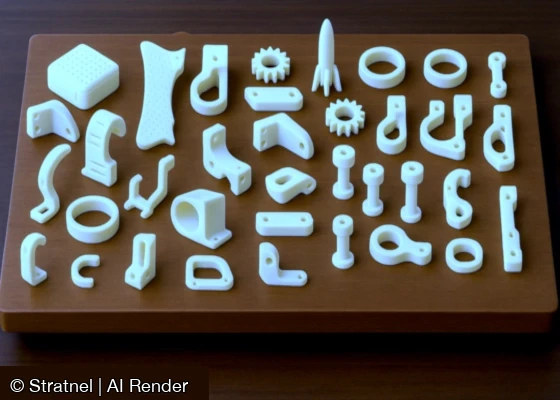
Sls Design Freedom
Design Capabilities
Six Things SLS Does That Other Processes Cannot

Understanding these capabilities is the starting point for designing parts that take full advantage of SLS.

Internal Geometry

Ducts, channels, and hollow cavities that would require multi-part assembly in any other process are produced as single integrated parts. No joints, no sealing, no assembly labour.

Assembled-in-Place

Hinges, sliders, ball joints, and interlocking features can be printed already assembled and functional — with controlled clearances for smooth movement.

Complex Thin Walls

Wall thicknesses down to ~0.8mm with good structural integrity. Ideal for lightweight enclosures, complex shells, and parts where every gram matters.

Lattice Structures

Reduce part weight substantially while maintaining structural performance through integrated lattice or honeycomb infill — a design approach unique to additive manufacturing.

Small Production Runs

10 to 500 parts per batch, without tooling. Mix different parts in a single build. Ideal for pilot production, spare parts programmes, and low-volume end-use supply.

Surface Finishing

Fine matte surface off the machine. Dyeable in a range of colours, paintable, and tumbling capable, for improved aesthetics. Near-production appearance without tooling investment.

SLS Material 01
PA12 — Nylon 12

PA12 Nylon is Stratnel's primary material for rigid, functional SLS 3D-printed parts. PA12 is a tough, slightly flexible engineering nylon with excellent fatigue resistance, long-term dimensional stability, and good chemical resistance. It produces parts with a fine-grained matte surface that is fully functional for structural use.

PropertyValue
Tensile strength (X, Y, Z)50 MPa — isotropic across all build directions
Tensile modulus1700 MPa
Elongation at break (flat)16%
Melting temperature187°C
Chemical resistanceGood — resistant to oils, greases, and many solvents
Surface finishFine matte — dyeable and paintable
Support structuresNone — powder bed provides all support
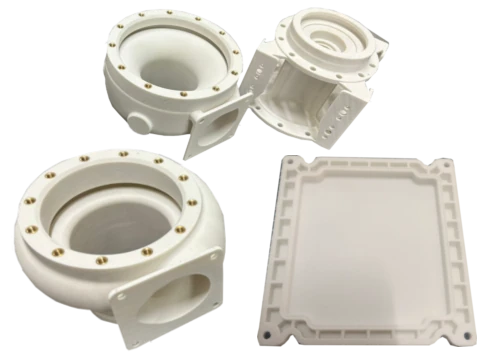
Best forComplex functional parts, ducting, enclosures, living hinges, snap-fits, small production runs

* Values are indicative. Actual properties vary with build orientation and print parameters.

Sls Pa12
SLS Material 02
TPU 88A — Flexible Polyurethane

Thermoplastic Polyurethane at 88A Shore hardness — A rubber-like SLS elastomer combining high flexibility, abrasion resistance, tear resistance and excellent elasticity. TPU 88A can be stretched, compressed, and repeatedly deformed without permanent damage. It delivers complex geometries impossible to mould, with zero tooling required.

PropertyValue
Shore hardness88A — firm rubber, compressible under load
Tensile strength8 MPa
Tensile modulus75 MPa
Elongation at break270% — highly elastic
Flexural modulus70 MPa
Impact strengthNo break at 23°C
Melt temperature120–150°C
Hydrolysis resistanceGood — suitable for humid environments
Support structuresNone — full design freedom in flexible material
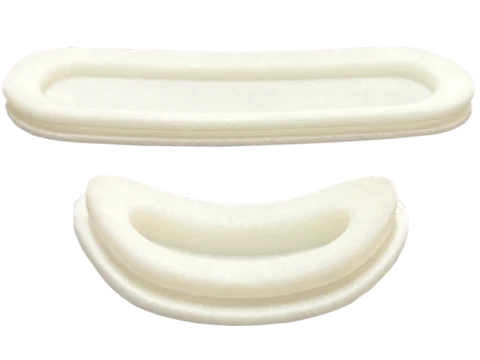
Best forSeals, gaskets, flexible grips, vibration dampers, overmould prototypes, complex flexible enclosures

* Values are indicative. Actual properties vary with build orientation and print parameters.

Sls Tpu
Applications
Where SLS Excels

SLS is the preferred process when geometry is complex, volumes are low, and tooling investment is not justified.

Sls Applications Banner
Automotive

Air ducts, distribution housings, bracket assemblies with complex internal routing, and under-bonnet components where geometry rules out other processes.

Electronics & EMS

Enclosures with integrated cable routing, complex connector housings, and test fixtures with internal cavities — produced without tooling.

Industrial Equipment

End-of-arm tooling for robots, jigs with integrated clamping features, and production aids where complex geometry directly improves function.

Medical Equipment

Complex housings for diagnostic instruments with integrated mounting features, internal partitions, and access features — as single printed parts.

Low-Volume Production

When you need 20–300 functional parts and tooling cost cannot be justified — SLS delivers end-use quality nylon parts without a mould.

Flexible Components

Seals, gaskets, flexible grips, and vibration dampers in TPU 88A — complex flexible geometries that silicone moulding cannot produce without expensive tooling.

Detailed material datasheets are available upon request. To receive technical documentation for a specific material, please submit an enquiry with your application details.

Common Questions
Frequently Asked Questions

What is the maximum part size you can produce?

Maximum part size depends on the selected manufacturing process and available equipment. For FDM, Stratnel can produce parts up to approximately 1 metre in each dimension, subject to part geometry and machine availability.

Larger components may be divided into sections, printed separately, and assembled. Stratnel can design and print dedicated assembly fixtures to help align such sections accurately.

SLA, SLS, and vacuum casting are generally used for smaller components, often around 200 mm, although actual capacity depends on the selected equipment, geometry, and process. Please share your design so that we can confirm feasibility.

Which materials can you print?

Stratnel offers a broad range of polymer materials. The appropriate material depends on the application, operating environment, required properties, and manufacturing process. Typical options include:

  • FDM: ULTEM™ 9085, PA6-CF, ASA, PETG, ABS, PLA, PC-ABS-FR, and other engineering thermoplastics.
  • SLS: PA12 (Nylon) for rigid parts and TPU 88A for flexible parts.
  • SLA: Standard, tough, clear, and other application-specific photopolymer resins.
  • Vacuum casting: Tough, clear, glass-filled, flexible, and other polyurethane resin systems.

Share your application and performance requirements with Stratnel, and we can recommend a suitable process and material. Relevant material datasheets can also be provided.

What dimensional accuracy and tolerances can you achieve?

The achievable accuracy depends on the printing process, material, part geometry, orientation, size, and post-processing requirements. Unless otherwise agreed, our indicative process tolerances are:

ProcessIndicative Tolerance
FDM± 0.5% of nominal dimension or ± 0.3 mm, whichever is greater
SLA, SLS & Vacuum Casting± 0.3% of nominal dimension or ± 0.2 mm, whichever is greater

These are general process guidelines and do not constitute a tolerance commitment for every feature. Please identify all critical dimensions and tolerances in a drawing when requesting a quotation so that Stratnel can review their feasibility and agree on an appropriate inspection plan.

Measurements are typically taken using calibrated vernier callipers and/or a height gauge on a surface plate. Our standard inspection generally covers selected, readily measurable dimensions across the three principal axes; it is not a complete inspection of every dimension in the drawing or CAD model. Full dimensional inspection or inspection of additional characteristics can be arranged when agreed before production.

What is the usual production lead time?

Production lead time depends on current machine availability, the size and geometry of the parts, print duration, order quantity, material, post-processing, inspection, and packaging requirements. Finishing processes such as painting may add a few days to the schedule.

We will provide an estimated dispatch date when quoting or confirming your order.

Have more questions? View our complete FAQ directory →

Need SLS Parts?

Complex geometries, no supports, functional nylon or flexible TPU. Quote same day.

Get a Quick Quote ↗
Quick Quote
Get In Touch
How can we help?

Choose an option below and we will get back to you.

Email Stratnel
Write to us at sales@stratnel.com
🔔
Subscribe to Free Services
Blogs, newsletter & promotions
📞
Request a Call Back
We’ll call you back within the day