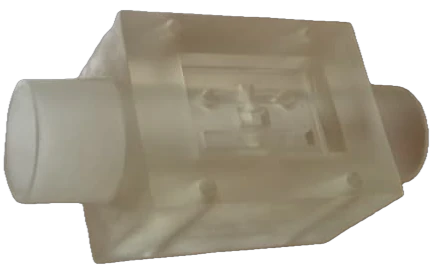
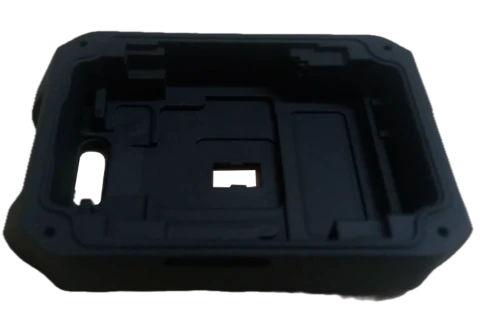
Stereolithography uses a UV laser to cure liquid photopolymer resin into parts with exceptional surface finish and dimensional accuracy. It is the preferred technology for master patterns used in vacuum casting, high-detail visual models, and transparent components.
Our most versatile SLA resin — a general-purpose photopolymer with excellent dimensional accuracy and smooth surface finish. Suitable for concept models, presentation prototypes, and master patterns for vacuum casting.
| Property | Value |
|---|---|
| Material resembling | ABS-like |
| Tensile strength | 35–46 MPa |
| Tensile modulus | 2433–2848 MPa |
| Elongation at break | 4.8–7.6% |
| Impact strength (Izod notched) | 28–48 J/m |
| HDT at 0.45 MPa | 60–63°C |
| Shore D hardness | 80–86 |
| Best for | Concept models, presentation prototypes, vacuum casting masters |
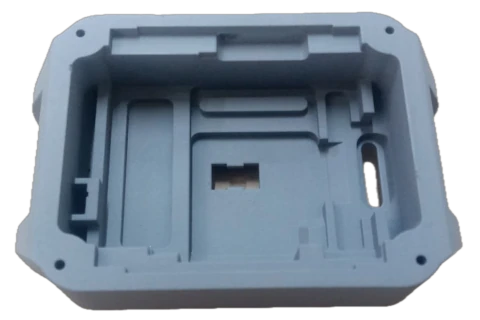
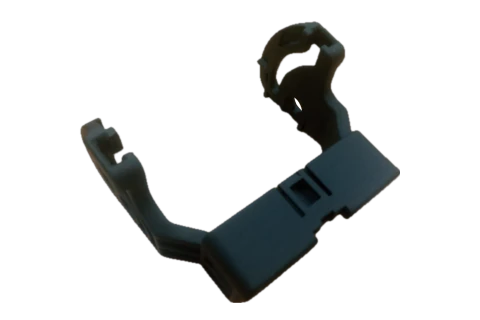
An engineering resin formulated for high toughness and impact resistance. Notably flexible with 40% elongation at break — significantly less brittle than standard SLA resins.
| Property | Value |
|---|---|
| Material resembling | Nylon-like |
| Tensile strength (yield) | 51 MPa |
| Young's modulus | 1800 MPa |
| Elongation at break | 40% — high toughness |
| Impact strength (Izod notched) | 45 J |
| HDT at 0.455 MPa | 75°C |
| Shore D hardness | 80 |
| Best for | Functional prototypes, jigs, snap-fit parts, impact-tested components |

Optically transparent SLA resin that can be post-processed to near-optical clarity. Used for fluidic channels, light guides, lenses, and any application where internal visibility or transparency is required. Simple geometries achieve near-optical clarity; for complex geometries, expect high translucency rather than full transparency.
| Property | Value |
|---|---|
| Material resembling | Acrylic-like |
| Tensile strength (yield) | 39 MPa |
| Young's modulus | 1200 MPa |
| Elongation at break | 6% |
| Impact strength (Izod notched) | 25 J |
| HDT at 0.455 MPa | 75°C |
| Shore D hardness | 82 |
| Transparency | Near-optical clarity with sanding and polishing |
| Best for | Fluidic devices, light guides, transparent covers, lenses |

High-temperature SLA resin with a significantly elevated heat deflection temperature after UV and thermal post-cure. Suitable for under-bonnet automotive testing, airflow testing, and applications requiring thermal stability beyond standard resins.
| Property | Value |
|---|---|
| Material resembling | High Temperature |
| Tensile strength (UV+Thermal cure) | 85.4 MPa |
| Tensile modulus (UV+Thermal cure) | 4816 MPa |
| Impact strength (UV+Thermal cure) | 71.4 J/m (notched Izod) |
| HDT at 0.45 MPa (UV+Thermal cure) | 165°C |
| Shore D hardness | 75–80 |
| Trade-off | More brittle than standard resins — lower elongation at break |
| Best for | High-temperature prototypes, airflow testing, under-bonnet automotive |

Detailed material datasheets are available upon request. To receive technical documentation for a specific material, please submit an enquiry with your application details.
Maximum part size depends on the selected manufacturing process and available equipment. For FDM, Stratnel can produce parts up to approximately 1 metre in each dimension, subject to part geometry and machine availability.
Larger components may be divided into sections, printed separately, and assembled. Stratnel can design and print dedicated assembly fixtures to help align such sections accurately.
SLA, SLS, and vacuum casting are generally used for smaller components, often around 200 mm, although actual capacity depends on the selected equipment, geometry, and process. Please share your design so that we can confirm feasibility.
Stratnel offers a broad range of polymer materials. The appropriate material depends on the application, operating environment, required properties, and manufacturing process. Typical options include:
Share your application and performance requirements with Stratnel, and we can recommend a suitable process and material. Relevant material datasheets can also be provided.
The achievable accuracy depends on the printing process, material, part geometry, orientation, size, and post-processing requirements. Unless otherwise agreed, our indicative process tolerances are:
| Process | Indicative Tolerance |
|---|---|
| FDM | ± 0.5% of nominal dimension or ± 0.3 mm, whichever is greater |
| SLA, SLS & Vacuum Casting | ± 0.3% of nominal dimension or ± 0.2 mm, whichever is greater |
These are general process guidelines and do not constitute a tolerance commitment for every feature. Please identify all critical dimensions and tolerances in a drawing when requesting a quotation so that Stratnel can review their feasibility and agree on an appropriate inspection plan.
Measurements are typically taken using calibrated vernier callipers and/or a height gauge on a surface plate. Our standard inspection generally covers selected, readily measurable dimensions across the three principal axes; it is not a complete inspection of every dimension in the drawing or CAD model. Full dimensional inspection or inspection of additional characteristics can be arranged when agreed before production.
Production lead time depends on current machine availability, the size and geometry of the parts, print duration, order quantity, material, post-processing, inspection, and packaging requirements. Finishing processes such as painting may add a few days to the schedule.
We will provide an estimated dispatch date when quoting or confirming your order.